


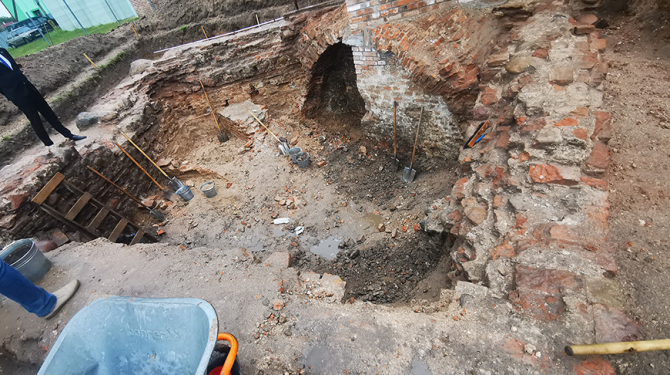
Archaeologists have unearthed two towers of the original Sapieha Castle, dating back to the late 16th – early 17th centuries, on the grounds of the palace in Ruzhany, BelTA learned from the culture department of the Pruzhany District Executive Committee.
The restoration work is being carried out under the supervision of archaeologists. Excavations are currently underway on the grounds of the main building. Thanks to the meticulous efforts of the specialists, the original foundations of two towers from the 17th-century Sapieha Castle have been brought to light. At the same time, surveys are being conducted to study their layout, structural features, and the surrounding cultural layer.
The archaeologists have uncovered the corner (northeastern) tower and the southern (central) tower. “The corner tower had been excavated earlier. The archaeological work there was carried out back in the 1990s. This year, it was decided to dig it out again for a detailed study of its structure,” the culture department explained. “The southern tower was found by accident. We knew about it from the architectural drawings. Last summer, restorers were clearing the foundation when they came across some masonry. Following Becker's plans [German architect Jan Samuel Becker, who in the mid-18th century remodeled the Sapieha castle into a palace], we began tracing the outlines to find proof that it was indeed a tower. We located the corners and passed the information on to the archaeologists.”
This summer, the archaeologists got to work and unearthed the foundation of the southern tower. This confirmed the information that the castle of Lew Sapieha originally had three towers. “The third is the western tower. Becker did not demolish it. The other two were destroyed during the conversion of the castle into a palace. The western tower was integrated into the overall ensemble of the main building. Restorers have also cleared it, uncovering an entrance to the cellars and a spiral staircase. We have found answers to many of the riddles left behind by the castle. We are convinced that many more discoveries still lie ahead,” the culture department added.
The purpose of the towers is largely understood from the inventory records. For instance, the corner tower housed Lew Sapieha’s study, while the southern tower contained a chapel. Like the entire castle, the towers served a defensive function.


